
Gum Treatments
The commonest cause of tooth loss is not decay but gum disease. It progresses quietly — first bleeding, then bone loss, then mobility. Caught early it can be stopped completely; caught late, the lost bone does not come back.
Gingivitis versus periodontitis
Gingivitis is inflammation confined to the gum, and bleeding on brushing is its classic sign. There is no bone loss at this stage, and professional cleaning plus corrected hygiene resolves it entirely — it is reversible.
Periodontitis is when the inflammation reaches the fibres and bone that hold the tooth. A pocket forms between gum and tooth, and as it deepens, cleaning becomes impossible. Lost bone does not return on its own; treatment aims to halt progression and, where feasible, regenerate.
Stages of treatment
The first stage is non-surgical: scaling and root planing. Plaque and calculus are removed from the pocket and the root surface is smoothed so tissue can reattach. For most patients this stage is sufficient.
Deep pockets need flap surgery: the gum is reflected so the root surface can be cleaned under direct vision, with bone graft and membrane placed where indicated. For recession, a connective tissue graft is used to cover the root — improving both sensitivity and appearance.
The process
Pocket depths are probed and bone levels read radiographically.
Calculus and plaque are removed ultrasonically.
Root surfaces are planed quadrant by quadrant.
Pockets are re-measured after six weeks.
Flap surgery, grafting or gingivoplasty.
Related services
- Scaling / debridement
- Subgingival curettage
- Flap surgery
- Gingivectomy / gingivoplasty
- Free & subepithelial connective tissue grafts
- Periodontal splinting
A treatment plan and its costing are prepared individually after examination.
Common questions
Healthy gums do not bleed when brushed. Bleeding is the earliest and most reliable sign of inflammation. The good news is that at this stage it is usually fully reversible. The bad news is that treating bleeding as "normal" for years ends in bone loss.
No. The ultrasonic tip fractures calculus by vibration; it does not cut enamel. The feeling that "gaps have opened up" afterwards is the space the calculus was occupying becoming visible — the space was already there. Transient sensitivity can last a few days.
It depends on the degree of mobility and the remaining bone. With slight mobility, treating the inflammation often firms the tooth up; in advanced cases splinting to the neighbours provides support. If most of the bone is gone, extraction and an implant is the more predictable answer.
Partly. A connective tissue graft can cover the exposed root surface, improving both cold sensitivity and appearance. But the cause must be addressed first — if aggressive brushing, the wrong brush, clenching or an occlusal problem continues, the graft will recede in turn.
Who performs this treatment
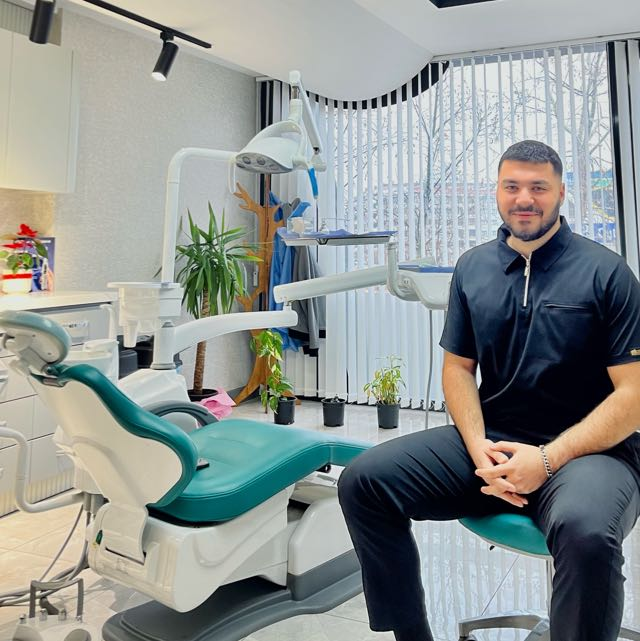
Dt. Han Demirci
Dentist · Aesthetic Dentistry & Implantology
- Digital smile design (DSD)
- Laminate veneers & zirconia
- Implantology
Dental Treatments
Impacted Teeth & Oral Surgery
Wisdom teeth, impacted teeth, cysts and abscesses — planned with CBCT imaging.
More →Dental TreatmentsDentures & Prosthetics
Full dentures, partials and precision-attachment solutions that seat properly and stay in place.
More →Dental TreatmentsBruxism & TMJ
Clenching, night grinding, jaw clicking and morning headaches: night guards and masseter botox.
More →Dental TreatmentsPreventive Care & Scaling
Six-month checks, scaling, fluoride and sealants — the work that makes treatment unnecessary.
More →Reach us.
WhatsApp is fastest — during opening hours we usually reply within minutes.
- AddressIsırgan Sk, Akfen Apt, Kat 1, Daire 2, Belediye Blv, Gönyeli, Nicosia
- Phone0548 818 12 12
- Emailinfo@smilexpert.com.tr
- Opening hoursMonday – Saturday · 09:00 – 19:00