
Laminate Veneers
A laminate veneer is a porcelain shell roughly 0.3–0.7 mm thick, bonded only to the visible surface of the tooth. It resolves shape, shade and length without cutting the tooth all round — in the right case, the most conservative aesthetic option there is.
What it solves
Gaps between teeth, mild crowding, worn-down incisors, enamel defects, tetracycline and fluorosis staining, chipped corners — veneers address all of these. Where irregularity is too slight to justify orthodontics, they give the result without waiting out braces.
The exclusions are equally clear: severe crowding, a compromised bite, teeth with extensive structural loss and uncontrolled clenching. Those need orthodontics, crowns or a night guard first — the foundation a veneer is built on has to be sound.
No preparation without a try-in
A mock-up before any preparation is mandatory in our veneer cases. The digital design is applied in temporary material, and you see it in the mirror, speak with it and photograph it. If something bothers you, nothing permanent has happened yet.
Once the mock-up is approved, preparation is carried out through that approved form — the design itself dictates how much is reduced. In some cases no reduction is needed at all (no-prep veneers), and only the try-in can establish that.
The process
Photographs, digital scan and smile-line analysis.
Tooth form and length designed to facial proportions.
The design is tried in the mouth and approved.
Minimal reduction through the approved form, digital scan.
Each veneer is adhesively bonded in turn.
Related services
- Ceramic laminate veneer
- Composite laminate veneer
- Direct composite laminate
- Digital smile design
- In-office whitening (beforehand)
A treatment plan and its costing are prepared individually after examination.
Common questions
Not the way a crown is. A veneer removes up to half a millimetre from the front surface only, and in some cases nothing at all. The back, incisal edge and side surfaces are largely preserved — that is the fundamental difference from a crown.
Once bonded, the porcelain behaves as one piece with the tooth and does not fracture under normal chewing. Failures usually come from outside forces: biting hard objects, nail biting, opening bottles, or uncontrolled clenching. Where bruxism exists, a night guard markedly extends the life of the veneers.
Porcelain veneers do not change colour; the glazed surface resists tea, coffee and tobacco staining. Composite veneers dull and discolour over time, which is why they have a shorter life. The one thing that can change is the shade of your remaining natural teeth.
It depends on how many teeth show when you smile. For most people the upper six to eight fill the smile window; a wide smile can need up to ten. A single veneer for one chipped tooth is possible, but shade matching is harder and the try-in stage takes longer.
Who performs this treatment
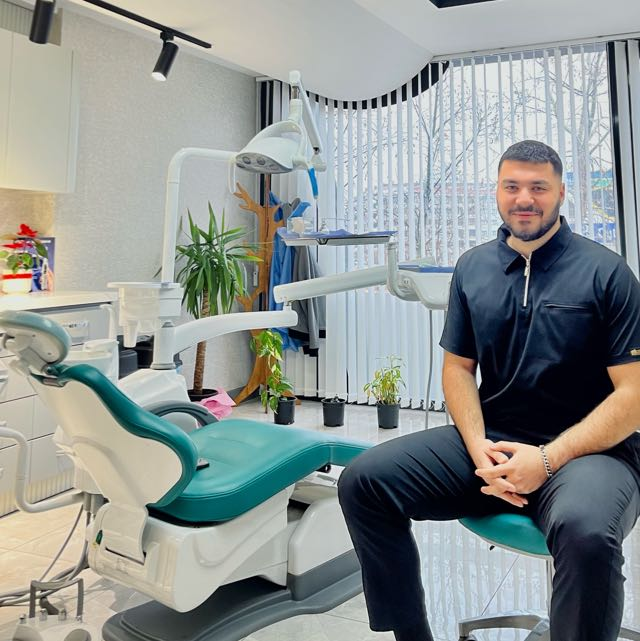
Dt. Han Demirci
Dentist · Aesthetic Dentistry & Implantology
- Digital smile design (DSD)
- Laminate veneers & zirconia
- Implantology

Dt. Eliz Mağracı
Dentist · Facial & Medical Aesthetics
- Botulinum toxin
- Dermal fillers & jawline
- Mesotherapy, Rejuran, exosomes
Dental Treatments
E-max All-Ceramic
Lithium disilicate ceramic with the highest translucency — the first choice for matching a single front tooth.
More →Dental TreatmentsDigital Smile Design
See the result on screen, then in your own mouth. Nothing permanent starts until you approve it.
More →Dental TreatmentsTeeth Whitening
In-office whitening: several shades in one session, controlled, with no loss of enamel.
More →Dental TreatmentsClear Aligners
Straightening with invisible, removable aligners — taken out to eat and to brush.
More →Reach us.
WhatsApp is fastest — during opening hours we usually reply within minutes.
- AddressIsırgan Sk, Akfen Apt, Kat 1, Daire 2, Belediye Blv, Gönyeli, Nicosia
- Phone0548 818 12 12
- Emailinfo@smilexpert.com.tr
- Opening hoursMonday – Saturday · 09:00 – 19:00