
Preventive Care & Scaling
The cheapest and most comfortable treatment in dentistry is the one never needed. Six-month checks catch decay before it hurts and gum disease before it costs bone. None of the procedures on this page requires anaesthetic.
What a check-up involves
An examination is not just a hunt for cavities. Pocket depths, margins of existing restorations, wear patterns, occlusion, tongue and cheek mucosa, a soft-tissue screen and bite-wing radiographs where indicated are all part of the same visit.
Bite-wings reveal interproximal decay that cannot be seen by eye. Caught on a radiograph, it is a small filling; by the time it is visible clinically it is usually close to needing root canal treatment.
Scaling and afterwards
Calculus is mineralised plaque and does not come off with a brush; it is fractured away with an ultrasonic tip and the teeth are then polished, since plaque adheres less readily to a smooth surface. The procedure is painless, though inflamed gums may bleed slightly.
A few days of cold sensitivity afterwards is normal, and a desensitising toothpaste helps. Smokers and heavy coffee or tea drinkers may need three cleanings a year rather than two; we set the interval from the state of the gums.
The process
Teeth, gums and soft tissues are assessed.
Bite-wings and a panoramic film where indicated.
Calculus and stain removed ultrasonically.
Surfaces polished and fluoride varnish applied.
Brushing, flossing and interdental technique shown.
Related services
- Cleaning & maintenance package
- Family check package (4 people)
- Student check package
- Sealants & fluoride
- Desensitising treatment
- Resin infiltration (Icon)
A treatment plan and its costing are prepared individually after examination.
Common questions
Yes — both decay and gum disease are symptomless early on. Pain signals that a problem has advanced, not that it has started. The point of a six-month check is to intervene at the stage you cannot detect yourself.
Every six months suits most people. For smokers, patients with a history of periodontal disease and those in orthodontic treatment we advise every three to four months. What sets the interval is how quickly calculus forms, and that varies from person to person.
Generally yes — oscillating-rotating and sonic models remove plaque more effectively. But the brush does not substitute for technique: two minutes, a 45-degree angle at the gum margin and reaching every surface still decide the outcome. Models with a pressure sensor are a particular help if you brush hard.
A brush cleans three of a tooth’s five surfaces and cannot reach the two interproximal ones — where a large share of decay begins. If floss is difficult, interdental brushes or a water flosser are good alternatives. What matters is that those two surfaces get cleaned, not which tool does it.
Who performs this treatment
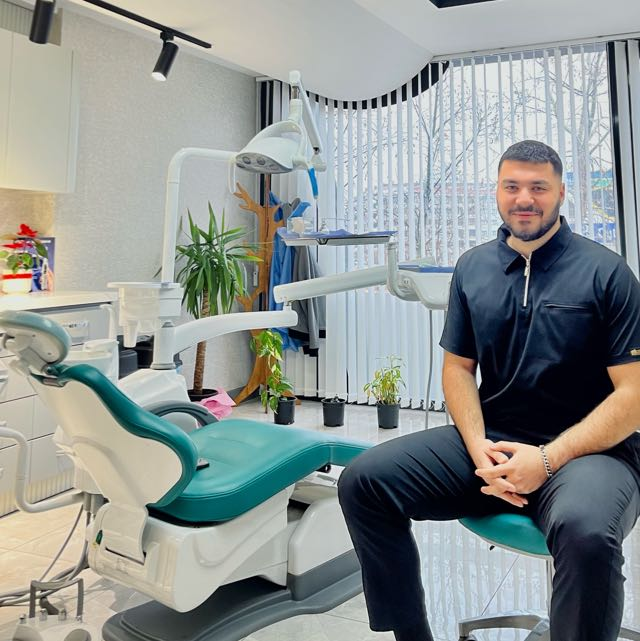
Dt. Han Demirci
Dentist · Aesthetic Dentistry & Implantology
- Digital smile design (DSD)
- Laminate veneers & zirconia
- Implantology
Related articles
Dental Treatments
Dental Implants
A titanium fixture in place of the missing tooth, with a crown on top. Guided surgery, CBCT planning, Nicosia.
More →Dental TreatmentsAll-on-4 & All-on-6
A full arch on four or six implants with a fixed bridge. You leave the clinic with temporary teeth the same day.
More →Dental TreatmentsZirconia Crowns
Metal-free crowns that transmit light and take load. Strength at the back, natural appearance at the front.
More →Dental TreatmentsLaminate Veneers
Thin porcelain shells bonded to the front surface only. Minimal reduction, maximum aesthetics.
More →Reach us.
WhatsApp is fastest — during opening hours we usually reply within minutes.
- AddressIsırgan Sk, Akfen Apt, Kat 1, Daire 2, Belediye Blv, Gönyeli, Nicosia
- Phone0548 818 12 12
- Emailinfo@smilexpert.com.tr
- Opening hoursMonday – Saturday · 09:00 – 19:00