
Fixed Braces
Fixed orthodontics works through brackets bonded to the teeth and an archwire connecting them. As the wire tries to return to its shape it applies continuous, controlled force. The reason a century-old method is still in use is simple: for complex movements it remains the most reliable.
Metal, ceramic or lingual
Metal brackets are the most durable and the fastest working option, and remain standard for children and teenagers. Ceramic brackets are tooth-coloured and go unnoticed at conversational distance, but they are more brittle and can lengthen treatment slightly.
In lingual orthodontics the brackets are bonded to the back of the teeth and are invisible from outside. Adaptation takes longer and the tongue is uncomfortable for the first weeks. Where an adult patient’s priority is visibility we assess aligners first; lingual comes up when the case cannot be solved with trays.
What sets the duration
Eighteen to twenty-four months on average — but that is an estimate, not a range you choose. What sets it: the degree of crowding, whether extractions are needed, whether there is a skeletal discrepancy, and age. In a growing patient the jaw can be guided; in an adult the same problem is compensated through tooth position alone.
Attending reviews on time affects duration directly. When four-weekly appointments are missed, the wire has finished its work and simply waits — treatment stalls. A broken bracket likewise suspends that tooth’s movement until the next visit.
The process
Cephalometric and panoramic films, model analysis, photographs.
Extraction or not, which mechanics — decided together.
Brackets are bonded and the first wire placed (60–90 min).
Wire changes, elastics and mini-screws where needed.
Brackets are removed and a retainer fitted the same day.
Related services
- Class I / II / III fixed treatment
- Short-term orthodontics
- Orthodontic start package
- Mini-screw anchorage
- Hawley & lingual retainers
A treatment plan and its costing are prepared individually after examination.
Common questions
Fitting them is painless and needs no anaesthetic. For the first three or four days there is pressure and tenderness on biting, and this recurs more mildly for a day or two after each wire change. Soft food and a simple painkiller are enough to get through it.
Yes. Tooth movement is not limited by age, only slowed a little. The real difference in adults is that skeletal problems can no longer be guided by growth; either dental compensation is used, or in advanced cases orthognathic surgery is considered. Gum health must be under control before treatment starts.
Not in every case. The decision comes from measuring the space available, after model analysis and cephalometric assessment. There are other ways to gain space — distalising the back teeth, minimal interproximal reduction, an expansion appliance. Extraction comes up when those are not enough.
An orthodontic brush, interdental brushes and a water flosser are all needed; ordinary brushing does not clean around brackets. Decay and gingivitis risk rise during treatment, so we recommend a professional clean every three months. Good hygiene is part of the treatment, not an optional extra.
Who performs this treatment
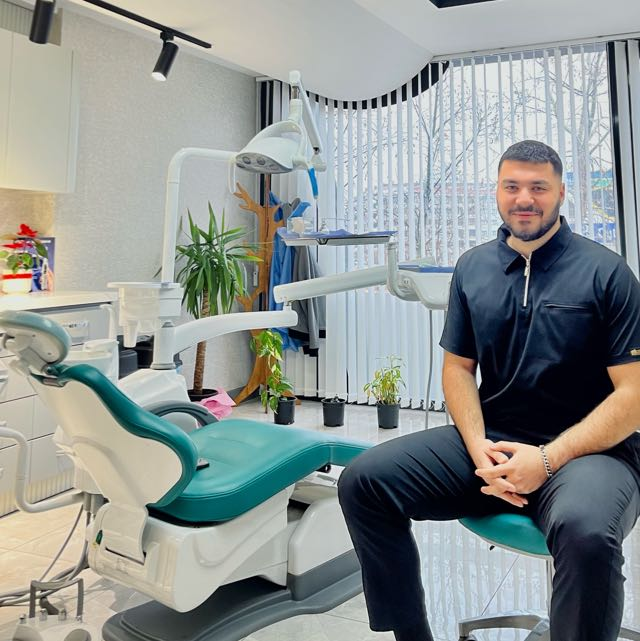
Dt. Han Demirci
Dentist · Aesthetic Dentistry & Implantology
- Digital smile design (DSD)
- Laminate veneers & zirconia
- Implantology
Dental Treatments
Paediatric Dentistry
From baby teeth to permanent ones: prevention, fissure sealants, space maintainers and a first visit without fear.
More →Dental TreatmentsRoot Canal Treatment
Saving a tooth when decay reaches the nerve — with rotary files and an apex locator, often in one visit.
More →Dental TreatmentsGum Treatments
Bleeding gums, recession and loose teeth: periodontal therapy, curettage, flap surgery and grafts.
More →Dental TreatmentsImpacted Teeth & Oral Surgery
Wisdom teeth, impacted teeth, cysts and abscesses — planned with CBCT imaging.
More →Reach us.
WhatsApp is fastest — during opening hours we usually reply within minutes.
- AddressIsırgan Sk, Akfen Apt, Kat 1, Daire 2, Belediye Blv, Gönyeli, Nicosia
- Phone0548 818 12 12
- Emailinfo@smilexpert.com.tr
- Opening hoursMonday – Saturday · 09:00 – 19:00