
Bruxism & TMJ
Bruxism is a clenching and grinding habit most people are unaware of. Its consequences are not limited to worn and fractured teeth: morning headaches, jaw and temple pain, neck tension and joint clicking all belong to the same picture.
Recognising the signs
Typical signs are jaw fatigue on waking, pressure at the temples, cold sensitivity, flattened incisal edges and repeated chipping at filling margins. Scalloped indentations along the tongue and a white line on the inside of the cheek are also common findings.
Clicking alone does not always need treating; pain, locking or restricted opening change the picture. Where those three are present an intra-articular problem is considered and imaging is arranged.
Night guard and botox
A night guard is a hard acrylic appliance that separates the teeth and stops wear. It does not abolish clenching but distributes the force and protects the teeth. Soft over-the-counter guards do not do this job and in some patients increase clenching — the appliance has to be custom-made.
Masseter botox reduces the muscle’s capacity for excessive contraction. Chewing and speech are unaffected; only the maximum force the muscle can generate falls. The effect lasts three to six months. In most cases we plan both together: the guard protects the teeth, the injection lowers the force.
The process
Wear, muscle tenderness and joint sounds are examined.
Premature contacts and occlusal balance are measured.
A hard occlusal splint is made from a digital scan.
A measured dose is applied to the masseter.
Guard adjustment and symptom review.
Related services
- Bruxism / night guard package
- Hard occlusal splint
- Stabilisation splint
- TMJ splint
- Masseter botox
- TMJ injection & physiotherapy
A treatment plan and its costing are prepared individually after examination.
Common questions
The evidence shows in the mouth: flattened incisal edges, notching at the necks of the teeth, tooth impressions along the tongue. Jaw fatigue and temple pressure on waking are typical too. These signs are easy to recognise at an examination — you do not need to have noticed it yourself.
Some slimming occurs over time — an overworked masseter is enlarged, and as force drops its bulk reduces. For patients bothered by a square jawline that is a bonus; for those who are not, the dose is set accordingly. The aim is to lower excessive force, not to abolish muscle function.
A properly designed hard splint does not — it is adjusted to contact all the teeth evenly. The risk comes from a guard that contacts only one area or has distorted. That is why we ask for periodic checks and adjustment when needed.
Without pain, locking or restricted opening, monitoring is usually enough. If any of those three is present, a disc position problem is considered, and splint therapy, physiotherapy and if needed intra-articular procedures come into play. Avoiding hard foods and wide opening is part of the treatment too.
Who performs this treatment
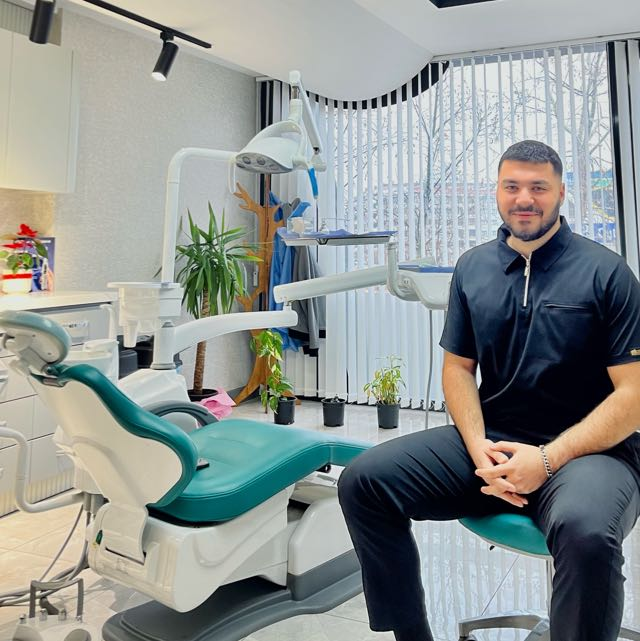
Dt. Han Demirci
Dentist · Aesthetic Dentistry & Implantology
- Digital smile design (DSD)
- Laminate veneers & zirconia
- Implantology

Dt. Eliz Mağracı
Dentist · Facial & Medical Aesthetics
- Botulinum toxin
- Dermal fillers & jawline
- Mesotherapy, Rejuran, exosomes
Related articles
Dental Treatments
Preventive Care & Scaling
Six-month checks, scaling, fluoride and sealants — the work that makes treatment unnecessary.
More →Dental TreatmentsDental Implants
A titanium fixture in place of the missing tooth, with a crown on top. Guided surgery, CBCT planning, Nicosia.
More →Dental TreatmentsAll-on-4 & All-on-6
A full arch on four or six implants with a fixed bridge. You leave the clinic with temporary teeth the same day.
More →Dental TreatmentsZirconia Crowns
Metal-free crowns that transmit light and take load. Strength at the back, natural appearance at the front.
More →Reach us.
WhatsApp is fastest — during opening hours we usually reply within minutes.
- AddressIsırgan Sk, Akfen Apt, Kat 1, Daire 2, Belediye Blv, Gönyeli, Nicosia
- Phone0548 818 12 12
- Emailinfo@smilexpert.com.tr
- Opening hoursMonday – Saturday · 09:00 – 19:00