
Impacted Teeth & Oral Surgery
An impacted tooth is one that has stayed within the jawbone or only partly erupted, most often a wisdom tooth. Not every impacted tooth needs removing — the decision follows its position, the damage it does to neighbours, and symptoms.
Remove or monitor
Recurrent infection (pericoronitis), decay or root resorption in the adjacent molar, cyst formation and interference with an orthodontic plan are all reasons to remove. A wisdom tooth fully within bone, causing no symptoms and putting no pressure on its neighbour, can simply be monitored.
We take a CBCT in every case. In the lower jaw, knowing the distance between the roots and the inferior alveolar nerve is essential; roots that appear superimposed on the nerve in a panoramic film can turn out to be millimetres away in 3D, or the reverse. That information dictates how the procedure is done.
Other surgical procedures
Oral surgery is not only wisdom teeth. Cyst enucleation, abscess drainage, frenectomy (lip or tongue tie), apicoectomy, biopsy and replantation after trauma all fall under this heading.
A tongue tie can affect feeding in infants and speech later, and is resolved with a simple frenectomy. An upper labial frenum is a common cause of a midline diastema and may need releasing before orthodontics.
The process
Position and distance to the nerve are seen in 3D.
Approach, incision and sedation are discussed.
20–45 minutes under local anaesthetic.
Cold compress, medication and diet instructions.
Sutures out on day seven and healing checked.
Related services
- Impacted tooth surgery (third molar)
- Surgical extraction
- Cyst enucleation
- Abscess drainage
- Frenectomy
- Coronectomy
- Biopsy
A treatment plan and its costing are prepared individually after examination.
Common questions
Not necessarily. A fully impacted tooth that puts no pressure on its neighbour and forms no cyst can be monitored. Partially erupted teeth are different: because they cannot be cleaned, they cause recurrent infection and decay in the adjacent molar. The decision is made from the radiograph — absence of symptoms alone is not enough.
After impacted-tooth surgery, swelling peaks on the second day and recedes from the third. Intermittent cold compresses in the first 24 hours reduce it markedly. Limited mouth opening is also possible and returns to normal within a week.
It is a recognised risk with lower impacted teeth, but with CBCT planning the rate is very low. Where roots sit very close to the nerve, coronectomy — removing only the crown and leaving the roots in place — is considered as an alternative. We discuss the risk case by case before the procedure.
For the first 24 hours do not rinse, spit or use a straw — dislodging the clot can cause a dry socket, which is very painful. Smoking carries the same risk for the first three days. Warm, soft food and taking the prescribed medication regularly is all that is otherwise needed.
Who performs this treatment
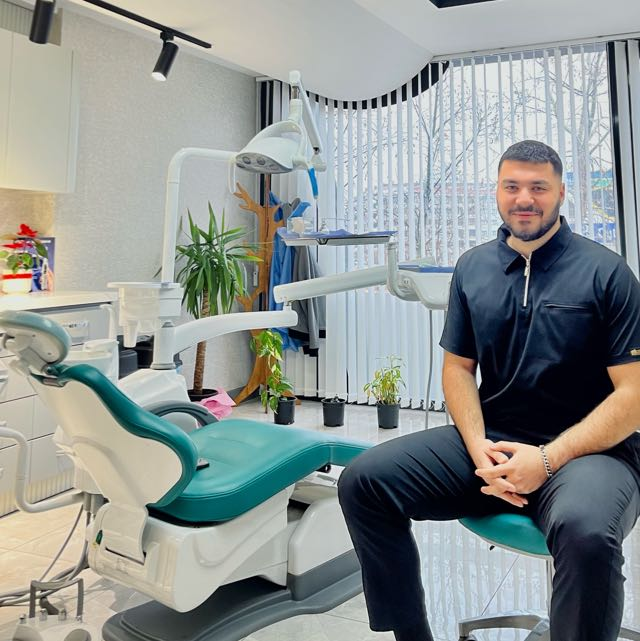
Dt. Han Demirci
Dentist · Aesthetic Dentistry & Implantology
- Digital smile design (DSD)
- Laminate veneers & zirconia
- Implantology
Dental Treatments
Dentures & Prosthetics
Full dentures, partials and precision-attachment solutions that seat properly and stay in place.
More →Dental TreatmentsBruxism & TMJ
Clenching, night grinding, jaw clicking and morning headaches: night guards and masseter botox.
More →Dental TreatmentsPreventive Care & Scaling
Six-month checks, scaling, fluoride and sealants — the work that makes treatment unnecessary.
More →Dental TreatmentsDental Implants
A titanium fixture in place of the missing tooth, with a crown on top. Guided surgery, CBCT planning, Nicosia.
More →Reach us.
WhatsApp is fastest — during opening hours we usually reply within minutes.
- AddressIsırgan Sk, Akfen Apt, Kat 1, Daire 2, Belediye Blv, Gönyeli, Nicosia
- Phone0548 818 12 12
- Emailinfo@smilexpert.com.tr
- Opening hoursMonday – Saturday · 09:00 – 19:00