
Clear Aligners
Aligner treatment works through a series of clear trays that move the teeth in stages. Each tray is worn for ten to fifteen days, moves the teeth by fractions of a millimetre, and is followed by the next. The entire movement is planned digitally before treatment starts.
Where it works
Mild to moderate crowding, diastema, minor bite discrepancies and relapse after previous orthodontics all suit aligners. Adults choose them most often, because they raise no visibility issue at work.
Severe skeletal discrepancies, guiding an impacted tooth into the arch and large rotations may need fixed appliances. Some cases run as a combination: a few months of braces, then finishing with aligners. Digital planning shows clearly which route applies.
The 22-hour rule
There is one genuine condition: the trays must be worn at least 22 hours a day, out only for eating and brushing. Wear them less and the teeth do not reach their planned positions, treatment stretches and extra trays are needed.
We say this at the outset because what makes aligners easy is also the risk: they come out. With that discipline the result matches fixed braces; without it, progress is slower than braces.
The process
Digital scan, panoramic and cephalometric films.
Every movement is simulated step by step and shown to you.
The series is produced and the first set handed over.
Checks every 6–8 weeks; attachments added if needed.
A lingual retainer and night retainer hold the result.
Related services
- Clear aligners — mild / moderate / complex
- Orthodontic start package
- Model analysis
- Lingual retainer
- Hawley retainer
A treatment plan and its costing are prepared individually after examination.
Common questions
A slight lisp is possible for the first few days, then the tongue adapts and it disappears. Because the trays are thin, adaptation is quicker than with fixed braces. They can come out briefly before a presentation or meeting — as long as the 22-hour total is preserved.
No — they come out for every meal. Eating with them in deforms the trays and traps food underneath, which risks decay. Nothing but water should be drunk with them in, especially hot drinks. Brush after eating, then put them back.
Not in suitable cases — for mild to moderate crowding the timelines are comparable, sometimes shorter. The difference is that it depends on consistent wear. For complex cases needing large movements, fixed braces remain more predictable.
Without retention, yes — that is true of all orthodontics. So at the end we bond a fine wire behind the teeth (a lingual retainer) and provide a clear retainer for night wear. Retention is an inseparable final stage of the treatment.
Who performs this treatment
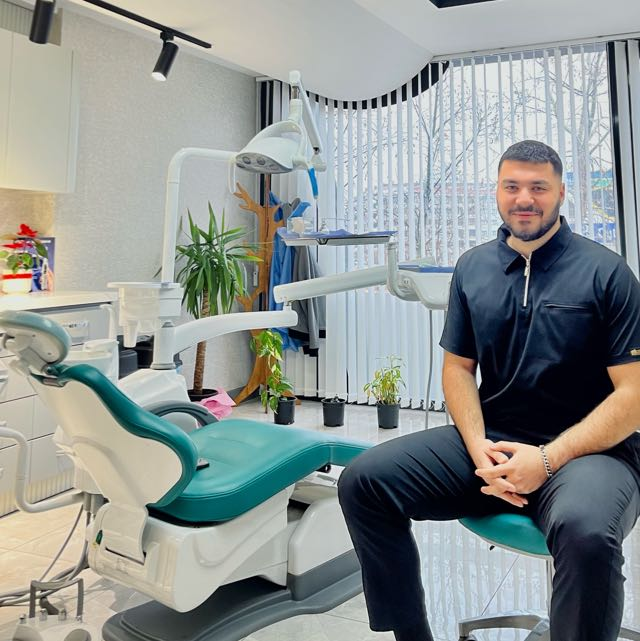
Dt. Han Demirci
Dentist · Aesthetic Dentistry & Implantology
- Digital smile design (DSD)
- Laminate veneers & zirconia
- Implantology
Dental Treatments
Fixed Braces
Straightening with brackets and archwires — the most predictable method in complex cases.
More →Dental TreatmentsPaediatric Dentistry
From baby teeth to permanent ones: prevention, fissure sealants, space maintainers and a first visit without fear.
More →Dental TreatmentsRoot Canal Treatment
Saving a tooth when decay reaches the nerve — with rotary files and an apex locator, often in one visit.
More →Dental TreatmentsGum Treatments
Bleeding gums, recession and loose teeth: periodontal therapy, curettage, flap surgery and grafts.
More →Reach us.
WhatsApp is fastest — during opening hours we usually reply within minutes.
- AddressIsırgan Sk, Akfen Apt, Kat 1, Daire 2, Belediye Blv, Gönyeli, Nicosia
- Phone0548 818 12 12
- Emailinfo@smilexpert.com.tr
- Opening hoursMonday – Saturday · 09:00 – 19:00